|
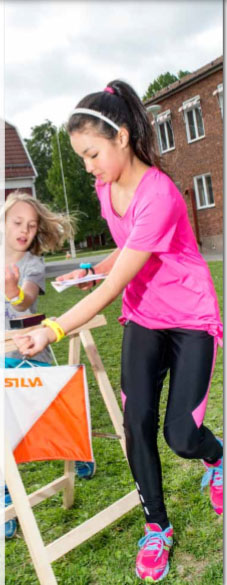
ORIENTEERING AT SCHOOL is easy to implement if you are
well prepared. Our experience is that the knowledge of
how to teach orienteering at school is very diverse and
the reasons are many. The availability or lack of teaching
materials as well as preparation time are the key impediments
to teaching orienteering in schools.
ACCESS TO LEARNING MATERIALS, primarily map but also
compasses, orienteering markers and punching systems
is very different in schools today. The Swedish National
Agency for Education through its clarification of the curriculum
imposed municipality and school to implement
teaching in an adequate and relevant manner and judge
the student’s level based grading system.
DURING AGES 7-12 years, students achieve a certain
knowledge of orienteering in ”known environment”.
During the Ages 13-15 years students achieve equivalent
knowledge of orienteering in ”unknown environment”.
The “known environment” means the campus/grounds
and its immediate vicinity. The unknown environment refers
nearby forest areas of outdoor character.
BASED ON EXPERIENCE from the project ”Skol-Sprinten”
and in close cooperation with primary school PE teachers,
we are now able to make orienteering teaching easy. These
guidelines will create better conditions for the teaching
and learning of orienteering at school.
WITH A MAP that corresponds to reality, clear exercises
structured in a pedagogical way, the right orienteering
equipment these all combine to assist teachers to deliver fun
orienteering lessons. This ”Teacher’s guide” will inspire all!
BASED ON EXPERIENCE from the project ”Skol-Sprinten”
and in close cooperation with the PE teachers at primary
school we have an idea how to make orienteering easier
at school. We want with these guidelines to create better
conditions for the teaching of orienteering at school.
WE BELIEVE THAT A MAP that corresponds to reality, finalised
exercises in a pedagogical approach and orienteering
equipment helps teachers to create fun lessons in orienteering.
This ”Teacher’s guide” will hopefully inspire all!
Stockholm January 20th 2015
Göran Andersson
|