-
Tu carro esta vacío!

Tu carro esta vacío!
”STEPS OF DEVELOPMENT” is a pedagogical description of how to learn orienteering in a clear sequential way. The basic elements come first followed by increasing difficulty.
THIS GUIDE IS A SUPPLEMENT to the Swedish Orienteering Federation’s book ”Orientera i skolan” and provides practical and concrete guidance how to utilise the school and its neighbourhood for teaching orienteering within the ”Physical Education” curriculum.
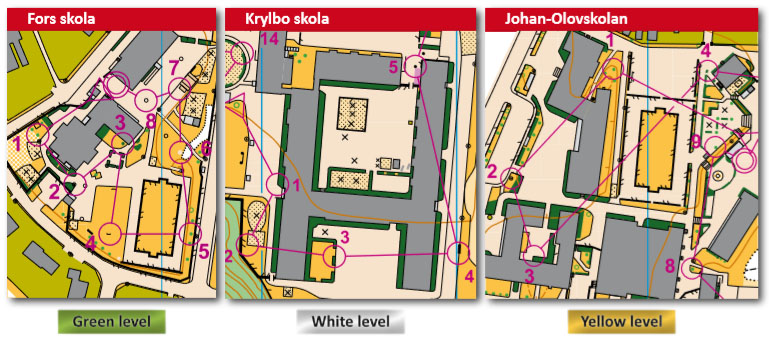
BASED ON THE LEVELS of green, white and yellow this guide contains a number of exercises which the teachers can transfer for use with their own school maps. If you don’t have access to any map of the school, i.e. educational material, there is more information in the back of the folder how to obtain functional educational materials for teaching.
DURING THE EARLY SCHOOL AGE learning starts at the green level. Many checkpoints provide regular ongoing feedback to reaffirm that the student is getting it right. The short legs to focus concentration. The next checkpoint should be visible once one finds their right control.
THREE KEY PRINCIPLES: Orientate the map, red to red and thumb your map. Students have to repeat and emphasise these three principles every learning opportunity. This is the basis for orienteering to be interesting and fun. When you understand how things fit together the students are looking forward to the next challenge.
WHITE LEVEL requires two to three map reading decisions to find the correct way to the control. In the beginning you navigate one step at a time. Over time every step is pulled together into a larger unit – “first south through the gate, follow the house to the east and then north along the hedge to the control.
THE YELLOW LEVEL is designed for teaching in secondary schools but parts of this level can be used at the end of middle school too. In particular, by using a small forest area nearby with some hills. An area where the kids normally play. Students get an understanding of what goes up and down on the map. The area is both known and safe for children.
IF SOMEBODY MAKES A MISTAKE and become a “little lost” it is better if this happens in the known and safe environment. They can return to the teacher and start again. If a child gets lost in less familiar terrain, the risk is very high that this experience will put them off for the rest of the school years, maybe even for life.
IT IS AN ADVANTAGE if a teacher is experienced at one level higher than they are teaching. For most teachers orangelevel is sufficient. As a teacher, you are the catalyst to enable learning orienteering to be as smooth as possible. Play and ’learning by doing’ are factors for success in learning something that can be a bit difficult and complicated. Therefore the school area, a good and updated map, a simple compass and a dedicated teacher are the foundation stones for successful learning and for a great, positive experience of orienteering.
COOPERATION with the local orienteering club is valuable. If the school can borrow electronic punching equipment this increases motivation to learning.